AI Voice Agents: What They Are and How They Work

An AI Voice Agent is a digital agent that can hold natural phone conversations with customers, understand their requests, use business data and complete specific actions during a call.

Unlike traditional IVR or a basic voice bot, an AI Voice Agent is not limited to predefined options. It can manage conversations dynamically, ask for clarification, connect with CRM, ERP, e-commerce platforms and other systems, and handle both inbound and outbound telephone processes.

The Voice Logica AI Voice platform enables businesses to create and manage AI Voice Agents.

What Is an AI Voice Agent?

An AI Voice Agent is artificial intelligence software designed to communicate through voice and telephone calls.

During a call, it can:

  • Listen to and understand the caller

  • Recognize their intent

  • Maintain the context of the conversation

  • Look up information in connected systems

  • Provide relevant answers

  • Perform approved actions

  • Ask for clarification when needed

  • Transfer the call to a person according to predefined rules

For the customer, the interaction takes place through a natural phone conversation. For the business, the Agent operates as an automated part of an actual business process.

AI Voice Agents and AI-powered Telephone Assistance

The terms AI Voice Agent and AI-powered telephone assistance often describe the same underlying category of technology: an AI system that can handle phone conversations without relying exclusively on static menus or scripts.

The real value, however, goes beyond the ability to hold a conversation. It lies in the Agent’s ability to connect voice with actual business data, rules and actions.

How Does an AI Voice Agent Work?

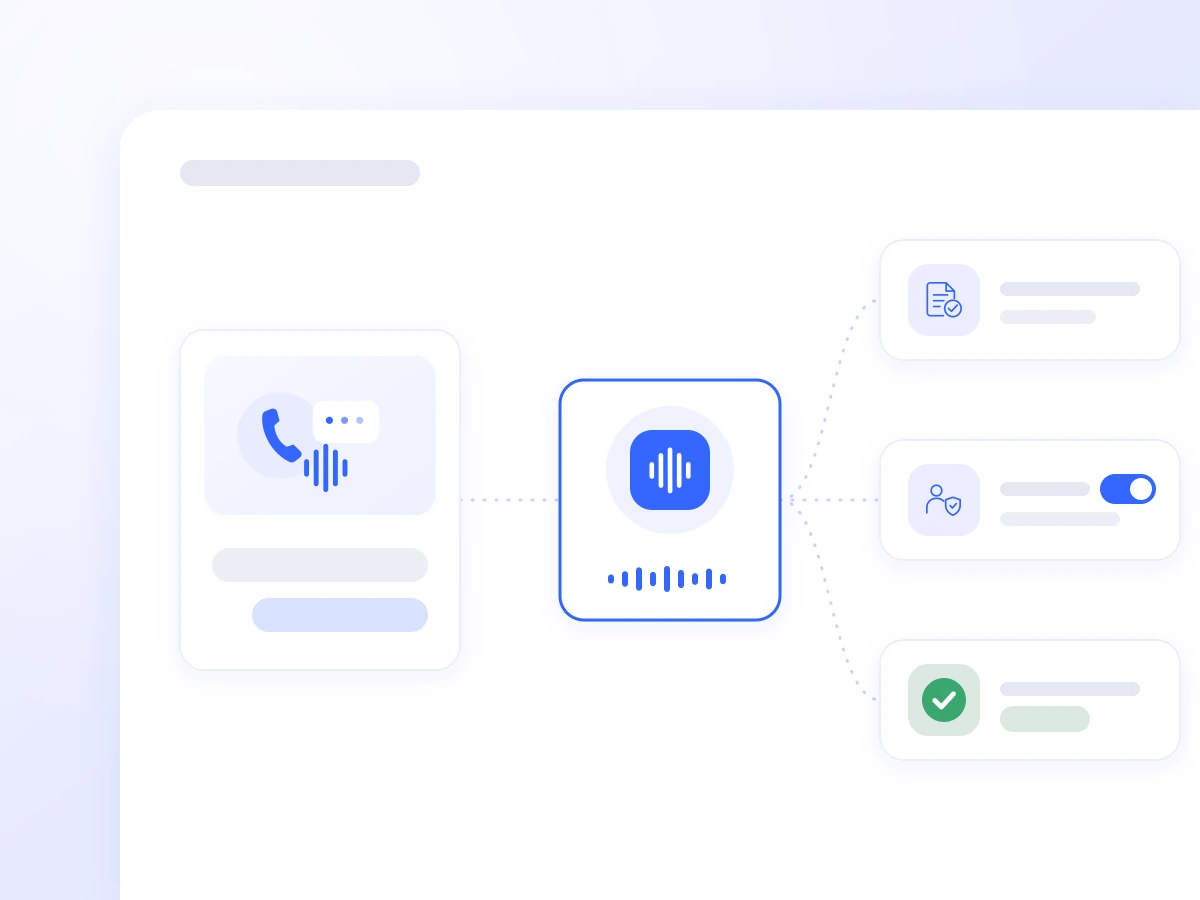
An AI phone conversation involves several different stages that take place almost simultaneously.

  1. It Understands What the Caller Says

    The Agent processes the caller’s speech and recognizes the content, intent and context of the request.

    The customer does not need to use specific words or follow a predefined menu.

  2. It Determines the Next Step

    Based on the defined instructions, knowledge and business rules, the Agent determines how the conversation should continue.

    It can answer, ask for more information or initiate a business action.

  3. It Retrieves Data from Business Systems

    Through integrations, it can retrieve authorized information from CRM, ERP, e-commerce platforms, calendars or custom applications.

    For example, it can check:

    • Order status
    • Product availability
    • Available appointments
    • Customer details
    • The progress of a request
  4. It Completes the Action

    The Agent can perform approved actions such as:

    • Scheduling an appointment
    • Recording or updating an order
    • Creating a ticket
    • Updating the CRM
    • Sending an SMS or email
    • Activating a workflow
    • Transferring the call to the appropriate team
  5. It Records the Outcome

    The call can be documented through a recording, transcript, summary and structured data, giving the business visibility into what customers ask for and how telephone processes progress.

What Can an AI Voice Agent Handle?

AI Voice Agents are not limited to a single application. They can be designed around specific telephone processes.

Inbound and Outbound AI Voice Agents

An AI Voice Agent can operate in both inbound and outbound call flows.

Inbound AI Voice Agent

It answers when the customer calls.

It is typically used for:

  • Customer service
  • Information
  • Orders
  • Appointments
  • Reception services
  • Routing and escalation

Outbound AI Voice Agent

It initiates telephone contact according to a predefined business process.

It is used for:

  • Appointment confirmations
  • Follow-ups
  • Updates
  • Reminders
  • Lead qualification
  • Large-scale calling campaigns

Both functions can coexist within the same organization and serve different needs.

AI Voice Agent or IVR?

Traditional IVR and an AI Voice Agent can both automate telephone processes, but they follow different approaches.

Compare AI Voice vs IVR
  • IVR Is Based on Options

    The caller follows a predefined path:

    “Press 1 for sales, 2 for support…”

    It is effective when the need is simple, consistent and predictable.

  • An AI Voice Agent Is Based on Conversation

    The customer describes what they need in their own words.

    The Agent understands the request, maintains context and dynamically adapts the conversation.

AI Voice does not always need to replace the existing IVR. It can work alongside it and handle only the processes where natural conversation delivers greater value.

AI Voice Agent or a Human-staffed Call Center?

AI Voice Agents are not suitable for every phone conversation.

The human team remains important when a case requires:

  • Judgment
  • Negotiation
  • Handling a serious complaint
  • Managing a complex exception
  • A professional or regulatory decision

AI Voice is particularly effective in processes that are:

  • Repetitive
  • High-volume
  • Based on clearly defined data
  • Governed by specific rules
  • Easily measurable

For many businesses, the most practical model is hybrid: the AI Voice Agent handles repetitive call volumes, while the human team handles cases requiring judgment or greater flexibility.

Compare AI Voice vs Call Center

Why Are Integrations Critical?

An AI Voice Agent becomes particularly useful when it goes beyond a static knowledge base.

Through integrations with CRM, ERP, e-commerce platforms and other business systems, it can use the same data the business uses.

This allows a phone conversation to lead to an actual business action.

For example, instead of simply saying:

“We will check your order,”

the Agent can look up the order and update the customer during the same call.

How Does an AI Voice Agent Connect with a PBX?

An AI Voice Agent does not necessarily require replacing the existing telephony infrastructure.

It can connect with the existing PBX and operate as part of the current call flow.

Depending on the business’s architecture, it can connect with:

PBX Integration
  • PBX systems

  • SIP infrastructure

  • Existing phone lines

  • IVR

  • Call routing

For example, it can answer calls to a specific number, operate only outside business hours or handle calls when no representative is available.

How Is an AI Voice Agent Created?

Creating an effective Agent starts with the business process, rather than its voice.

  1. Define the Role

    Which calls should it handle? What outcome should it achieve?

  2. Establish the Knowledge and Rules

    The Agent needs the right information, instructions, boundaries and escalation rules.

  3. Connect the Required Systems

    Integrations are added so it can retrieve data and complete actions.

  4. Test Real Scenarios

    Different questions, exceptions and conversation paths are tested before going live.

  5. Improve Through Real Calls

    Transcripts, summaries and analytics reveal what customers actually ask for and where adjustments are needed.

What Should a Business Evaluate Before Choosing an AI Voice Agent?

Choosing an AI Voice solution should involve more than assessing how natural the voice sounds.

Key criteria include:

  • Natural Language Understanding

    Can the Agent understand different ways of expressing a request and maintain context?

  • Integrations

    Can it connect with the systems the business already uses?

  • Actions

    Can it complete actual workflows or only answer questions?

  • Telephony Integration

    Can it work with the existing telephony infrastructure?

  • Security

    How are conversations, personal data and access to business systems protected?

  • Analytics and Control

    Can the business see what happened during calls and improve the Agent using real data?

Security and Data Protection

AI Voice Agents can access important business information. Security must therefore be part of the solution’s architecture, rather than an additional feature.

At Voice Logica, access is designed around:

Security & Compliance
  • Controlled permissions

  • Role-based access

  • Secure integrations

  • Data encryption

  • Protection of recordings and transcripts

  • GDPR compliance

  • Infrastructure within the European Union

Voice Logica holds ISO 27001 and ISO 27701 certifications for information security and privacy management.

AI Voice Agents in Greece

The Greek market has specific requirements for Voice AI.

Formal support for the Greek language is not enough. A solution must handle natural phrasing, different ways of expressing requests and real business processes in Greek.

Voice Logica is a Greek enterprise AI Voice company and platform that develops AI Voice Agents for businesses with telephone processes in Greek and English.

The Agents can handle inbound and outbound calls and connect with the business’s telephony and information systems.

Applications are already in use across areas such as:

Retail and e-commerce
Telecommunications
Services
Appointments
Customer service

AI Voice Agents in Real Businesses

The value of an AI Voice Agent is demonstrated through the processes it can handle in practice.

Youbath

Across more than 2,500 phone conversations, the Voice Logica AI Voice Agent achieved 86% full resolution without human intervention, handling requests about products, orders and information.

View the Youbath Case Study

Homepraktika

In the first weeks of operation, the AI Voice Agent handled 1,825 calls, with 46% of call activity taking place outside core business hours.

View the Homepraktika Case Study

Thiseas Technical Services

The Outbound AI Voice Agent made more than 20,000 outbound calls to schedule, confirm and reschedule FTTH technician appointments.

View the Thiseas Case Study

Where Should a Business Start?

The best initial implementation is not necessarily the largest.

It is usually a telephone process that:

  • Occurs frequently

  • Takes up significant team time

  • Follows relatively clear steps

  • Relies on available data

  • Has an easily measurable outcome

Examples include order status enquiries, appointment scheduling, common customer questions or a specific outbound process.

Once the first call flow is operating and has been evaluated, the Agent can gradually expand to additional use cases.

The Voice Logica AI Voice Platform

The Voice Logica AI Voice platform brings together the tools needed to create, connect, operate and continuously improve AI Voice Agents.

Through the platform, you can:

  • Create different Agents and call flows
  • Manage knowledge and instructions
  • Connect CRM, ERP and other systems
  • Handle inbound and outbound calls
  • Review recordings, transcripts and call analytics
  • Connect an existing PBX
  • Use APIs and webhooks
  • Manage Agents through AI assistants using MCP

Updated: